



By Laura Meshen
Posted in
September 22, 2020
What is a customer data platform and how does it work?
What is a Customer Data Platform?
And how does it work?
Customer data, you’ve got it and lots of it. Anonymous or first-party, behavioural, transactional and demographic customer-related data. Do you have a way of taking all those different types of data and connecting them in a way that will store, enrich and analyze that information for you? If not, a customer data platform may be your business's solution to make better decisions based on a dynamic, unified and complete 360 customer profile.
What is a customer data platform (CDP)?
- A packaged software that creates a persistent, unified customer database that is accessible to other systems.
- Gives marketing teams a complete 360° profile of your exact customer that is dynamically updated and statistically unified.
How does a CDP work?
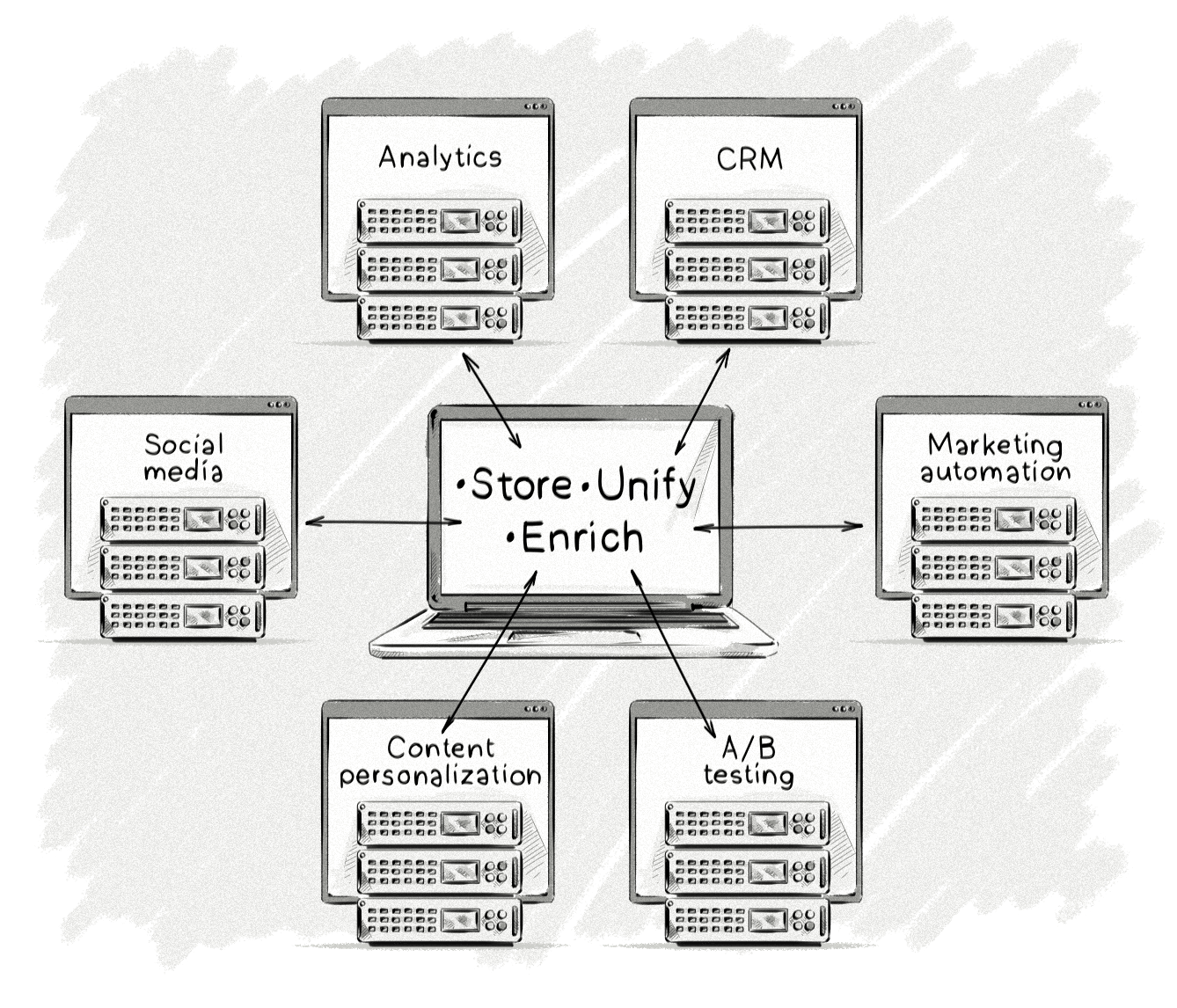
- A CDP provides a way for all your systems to deposit data into one centralized place where it can be stored, analyzed, updated and enriched for your teams to use.
Harnessing the power of your customer data is becoming more and more critical in today’s ecommerce landscape. Customers are becoming familiar with rich, dynamic user experiences across multiple channels and in-store. The businesses that are delivering those dynamic, unified experiences are the ones making sales. Customers expect that your business knows and remembers who they are, what they have searched for, how they like to pay, and what content they like to see from your company.
How do you provide that customer experience when that information comes from so many different sources? Disconnected data makes it very hard to bring all those data points together to deliver the right engagement to the right person at the right time. Customer Data Platforms are bridging that gap and bringing behavioural, transactional and demographic data together to create a truly unified customer profile that updates as the client interacts with the company across all their channels.
What is a customer data platform (CDP)?
“A Customer Data Platform is packaged software that creates a persistent, unified customer database that is accessible to other systems.”
Further defined, “A CDP puts your marketing team in direct control of the data unification project, helping to ensure it is focused directly on marketing requirements. CDPs apply specialized technologies and pre-built processes that are tailored precisely to meet marketing data needs. This allows a faster, more efficient solution than general-purpose technologies that try to solve many problems at once.” - CDP Institute, CDP Basics
But what does that really mean? It means that a CDP is designed to not only aggregate data from all your customer touchpoints but also analyze and give you insight, recommendations and an overarching view of your customers from data collected during their entire buyer journey.
To break it down further, it helps to look at two common tools in the ecommerce tech stack and show how they compare to CDP.
Not a customer relationship management (CRM) system
Per HubSpot: “CDP and Customer Relationship Management (CRM) tools both collect customer data and provide value to your organization. But the similarities stop there: where a CDP autonomously creates unified customer profiles with data gathered across a variety of online and offline channels, a CRM only tracks a customer’s intentional interactions with a company via manual entry.”
| CDP | CRM |
| Collects data on anonymous visitors | Reports on known or potential customers |
| Analyzes lifetime customer journeys and behaviour | Utilizes forecasting and sales pipeline info for reporting |
| Tracks online and offline customer data | Offline data must be annually entered |
| The potential for lost or replicated data is slim due to the ability to handle many data points across multiple sources | Collect individually entered data, which can be inadvertently mishandled, lost or mislabelled |
Not a data management platform (DMP)
“CDPs work with both anonymous and known individuals, storing ‘personally identifiable information’ such as names, postal addresses, email addresses, and phone numbers, while DMPs work almost exclusively with anonymous entities such as cookies, devices, and IP addresses.” - David Raab, founder of the CDP Institute
| CDP | DMP |
| All types of marketing improve with complete customer profiles | Used to influence advertising to target ads and reach audiences |
| Collect mostly first party data directly from customers | Collect mostly 3rd party data through data providers |
| Provide personalized, specific customer identifiers | Reflect anonymous customer identifiers (cookies, IP info, etc.) |
| Retain data over a long period of time to build in-depth, accurate customer profiles and nurture relationships | Retain data for a short period of time to target ads and build lookalike audiences |
CRMs and DMPs both provide valuable services for businesses. They have been a part of the enterprise tech stack for a long time and hold many data assets you need. A CDP outshines them in the ability to bring the data in those two systems together, along with other data from other systems like ERP, POS systems and marketing software, to give a complete 360-degree picture of your client profile.
This unified, persistent and dynamic customer view allows executive teams to understand the omnichannel user experience and how online ad spending influences offline behaviours. It will enable your marketing team to build highly targeted, personalized campaigns because they have complete, connected data. It allows your IT teams to access the data they need to measure and improve personalization, enriching the user experience online. It can even enable your brick-and-mortar stores to understand better what the in-store customer is doing online and identify ways to ease the combined experience.
How does a CDP work?
When you think of all the different systems that handle your day-to-day business, how many of them actively communicate with each other? Probably only a handful, right? A packaged customer software database, or CDP, provides a way for all the systems to dump their data into one centralized place and where it can be stored, analyzed, updated and enriched for your teams to use.
- Aggregate customer data types from multiple sources. This includes sorting and cleaning data that businesses have previously discarded as erroneous or not important because it was not immediately usable.
- Analyze the data from all these sources and create a persistent, dynamic customer profile that has varied uses: by marketing teams for better segmentation and personalization, by executives for business modelling and by engineering teams to consolidate the data pipeline and provide better reporting just to name a few.
The core capabilities of a CDP:
- Enriched, unified, persistent customer profiles — The data from all your systems are translated into a customer profile that updates dynamically.
- Multi-dimensional segmentation — Unified data means that you now have the ability to build cross-channel segments, behavioural and predictive segments.
- Customer lifecycle management — A 360-degree view of your customer’s journey can improve all your cross-channel lifecycle marketing campaigns.
A customer data platform is an investment in saving time, gaining insight through a unified customer profile and being better informed to give your customers the experience they are searching for. Improved customer experience leads to more sales, better buyer confidence and higher lifetime value.